
Stamp Duty on Transfer of Shares: Implications for Unquoted Equity Shares
Stamp duty on transfer of shares is an important compliance requirement that applies when unquoted equity shares are transferred through Form SH-4. While valuation and income-tax implications often receive significant attention, inadequate stamp duty compliance can invalidate the transfer, trigger penalties, delay corporate approvals, and create challenges during due diligence, funding rounds, or mergers and acquisitions.
Because unquoted equity shares are essentially unlisted shares, understanding the stamp duty implications on transfer of unlisted shares is equally important. For finance professionals, founders, company secretaries, and legal heads, it is crucial to understand when, how, and at what rate stamp duty applies. Proper compliance ensures that every share transfer is legally enforceable, accurately documented, and accepted by regulatory authorities.
Applicability of Stamp Duty on Transfer of Shares
When analysing stamp duty on transfer of shares, the legal framework is primarily governed by:
- Indian Stamp Act, 1899
- State-specific stamp duty notifications
- Companies Act, 2013 (Form SH-4)
Even though shares are movable property, their transfer – especially in physical form using SH-4 – requires stamp duty to be paid.
Key Points:
- Duty applies on the instrument of transfer (Form SH-4), not the share certificate.
- Transfer is not valid unless duty is paid and the instrument is duly stamped and executed.
- It applies to both resident and non-resident transactions, subject to additional FEMA compliance.
Basis of Valuation for Stamp Duty on Transfer of Shares
Stamp duty on transfer of shares is typically calculated on the higher of the consideration amount or the Fair Market Value (FMV) of the unquoted shares. This prevents undervalued transactions and ensures a uniform basis for revenue collection by state authorities.
Valuation Basis Includes:
- Transaction Value: Applicable when shares are transferred between unrelated parties on an arm’s-length basis.
- Fair Market Value (FMV): Required when the consideration is lower than FMV or in related-party, group restructuring, gift, or nil-consideration transactions.
- Rule 11UA (Income Tax Rules): Commonly used for determining FMV in tax, FEMA, and compliance contexts. Many states accept valuations certified under Rule 11UA or from a registered valuer for stamp duty assessment.
In practice, stamp authorities may request a valuation report supporting FMV for high-value transactions, intra-group transfers, or when the declared consideration appears understated.
State-Wise Stamp Duty Rates on Transfer of Shares
Stamp duty rates vary by state. Here’s a comparison of two key jurisdictions:
| State | Rate | Remarks |
|---|---|---|
| Maharashtra | ₹0.25 per ₹100 (0.25%) | Mandatorily affixed on SH-4 |
| Gujarat | ₹0.25 per ₹100 or part thereof | Must be stamped before or at the time of execution of SH-4 |
| Delhi | ₹0.25 per ₹100 or part thereof | Requires adhesive or e-stamp |
| Tamil Nadu | ₹0.25 per ₹100 | Physical stamps or franking required |
Improper stamping can result in non-registration of share transfer by the company.
Stamp Duty Compliance Process for Transfer of Shares
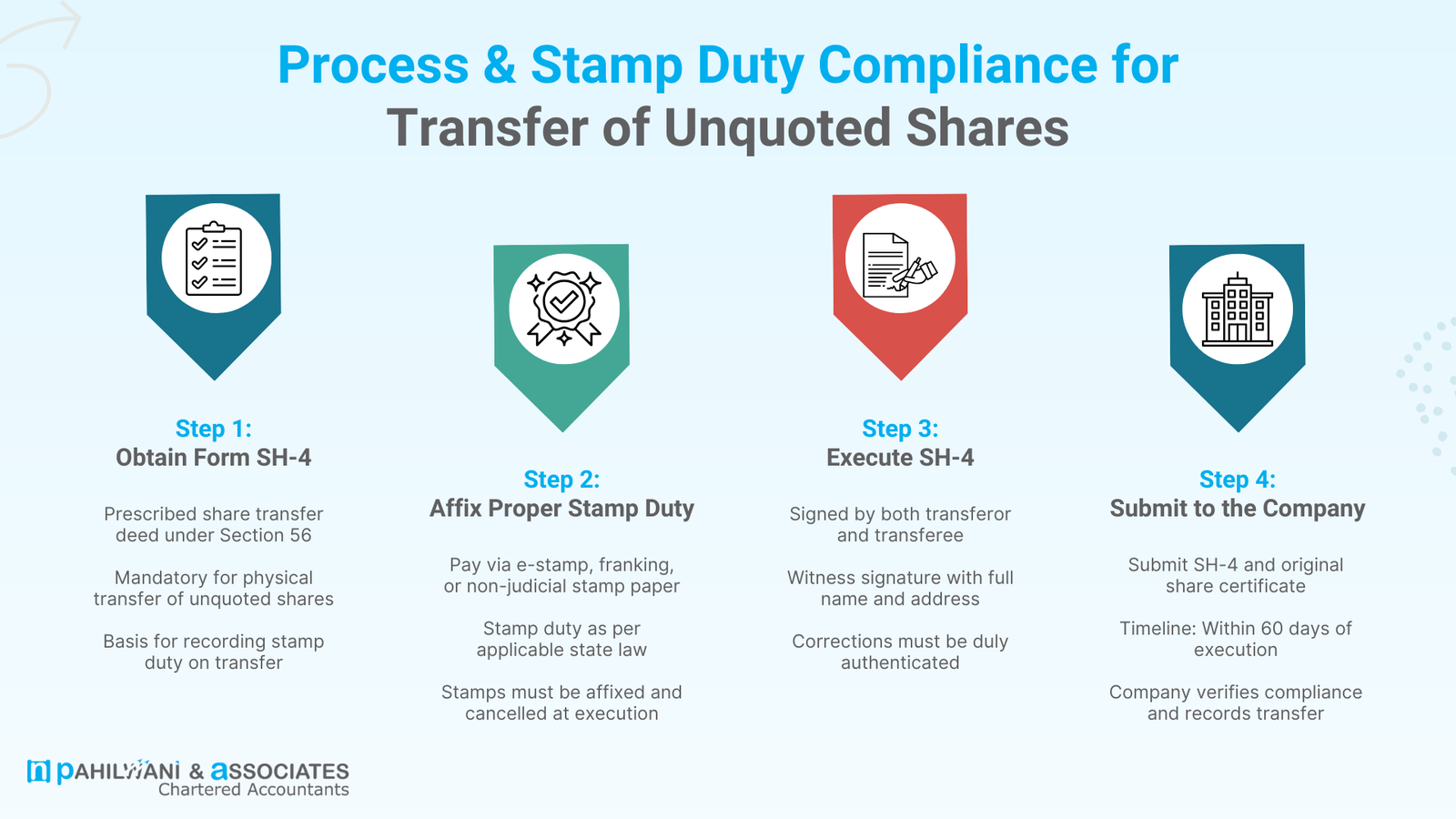
To complete a compliant transfer of unquoted equity shares, the following steps must be followed carefully. Proper execution is essential because the SH-4 deed is the primary document on which stamp duty on transfer of unlisted shares is recorded.
How to Comply
1. Obtain Form SH-4
The prescribed share transfer deed under Section 56 of the Companies Act, 2013.
It must be used for all physical transfers of unquoted shares.
2. Affix Proper Stamp Duty
- Pay stamp duty through non-judicial stamp paper, franking, or e-stamp, depending on state rules.
- Stamps must be affixed and cancelled before or at the time of execution.
- Incorrect or insufficient stamping may render the deed invalid.
3. Execution of SH-4
- SH-4 must be signed by both the transferor and the transferee.
- A witness must sign, providing full name and address.
- Any corrections or overwriting should be duly authenticated.
4. Submit to the Company
- The executed SH-4 form and original share certificate must be submitted within 60 days of execution.
- The company will verify:
- stamping
- signatures
- valuation (if applicable)
- completeness of documentation
- Upon approval, the company records the transfer and endorses the share certificate.
Documents Required
- Executed SH-4 with correct stamp duty
- Original share certificate or allotment letter
- PAN of transferor and transferee (mandatory in high-value transactions)
- Valuation report, if FMV is required or if the consideration appears lower than market value
- Any additional declarations requested by the company or ROC for compliance
Stamp Duty Table (Illustrative)
| Transaction Value | Stamp Duty @ 0.25% | State | Payment Method |
|---|---|---|---|
| ₹1,00,000 | ₹250 | Gujarat | E-stamp / Franking |
| ₹10,00,000 | ₹2,500 | Maharashtra | Non-judicial stamp paper |
| ₹25,00,000 | ₹6,250 | Delhi | Adhesive stamp |
Duty must be paid on full consideration, not per share.
Frequently Asked Questions
1. Is stamp duty required for digital share transfers?
No, for demat shares, stamp duty is auto-collected via depositories. It applies only to physical (SH-4) transfers.
2. Who pays stamp duty – buyer or seller?
Typically, it is borne by the transferee (buyer), unless mutually agreed otherwise.
3. Can SH-4 be executed without stamp duty?
No. An unstamped or insufficiently stamped SH-4 is not legally valid and will be rejected by the company.
4. Is stamp duty applicable for gift or zero consideration?
Yes, duty is applicable on the FMV of shares, even if transferred as a gift.
5. Is valuation compulsory for stamp duty purposes?
It is not mandatory for all transfers, but recommended if the transaction value is unclear or below FMV.
How Our Firm Can Help
At N Pahilwani & Associates, we help you navigate the complex interplay of stamp duty laws, share transfer procedures, and valuation compliance, including:
- Valuation Reports under Rule 11UA or FEMA
- Drafting and Executing SH-4 Transfer Deeds
- E-stamping / Franking Assistance State-wise
- Shareholder Agreements & Legal Documentation
- Cross-border Transaction Compliance (with FEMA/Income Tax)
Need to ensure your share transfer is legally bulletproof? Reach out to us for stamp duty and corporate law consulting.
Conclusion
Stamp duty on transfer of shares is a critical compliance requirement that should not be overlooked during the transfer of unquoted equity shares. While the cost may appear relatively small, non-compliance can lead to penalties, disputes over the validity of the transfer, delays in corporate actions, and challenges during investor due diligence or future transactions.
By ensuring proper valuation, timely payment of stamp duty, and correct execution of Form SH-4, companies can facilitate legally enforceable and compliant share transfers. Professional guidance helps ensure that every share transfer is accurately documented, compliant with applicable laws, and prepared for future regulatory, investment, or business requirements.