
Taxation of Foreign Companies in India: Income Tax and Compliance Framework
Introduction and Definition of Foreign Company under Income-tax Act
India has become a major destination for multinational corporations, foreign investors, and global institutions establishing operations, branch offices, and project presence. Companies planning market entry must first understand the process of foreign company registration in India, regulatory approvals, and taxation of foreign companies in India including income tax and compliance framework. While India offers significant market opportunities, foreign entities must understand the taxation framework governed primarily by the Income-tax Act, 1961, Double Taxation Avoidance Agreements (DTAA), and regulatory compliance requirements.
As per Section 2(23A) of the Income-tax Act, a foreign company means a company which is not a domestic company, i.e., a company incorporated outside India and not classified as a domestic company for tax purposes.
Under Indian tax law, foreign companies are taxable in India based on the following triggers:
- Income received or deemed to be received in India
- Income accrued or arising or deemed to accrue or arise in India
- Income attributable to a Permanent Establishment (PE) in India
Typical examples of foreign companies taxable in India include:
- Branch office of a foreign company
- Project office executing contracts in India
- Foreign company providing services in India
- Foreign universities conducting operations in India
This taxation framework ensures that foreign entities pay tax on income connected to India, regardless of their place of incorporation and is central to understanding foreign company income tax in India.
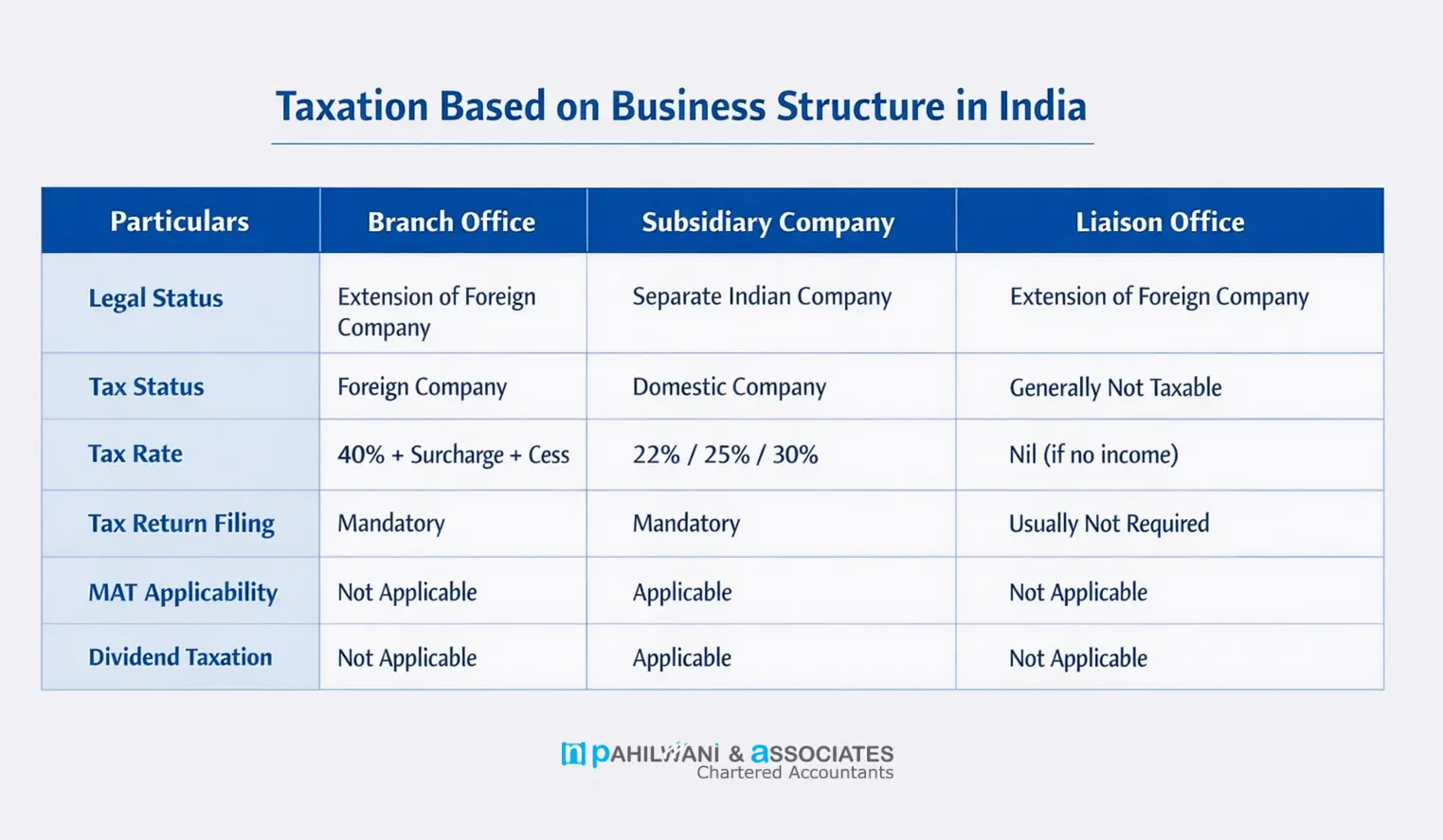
Taxation Based on Business Structure in India
The taxation of foreign companies in India varies significantly depending on the mode of presence in India. The structure chosen has a direct impact on tax rates, compliance burden, and overall tax efficiency.
Comparison Table: Taxation Based on Structure
| Particulars | Branch Office | Subsidiary Company | Liaison Office |
|---|---|---|---|
| Legal Status | Extension of foreign company | Separate Indian company | Extension of foreign company |
| Tax Status | Foreign company | Domestic company | Generally not taxable |
| Tax Rate | 40% + surcharge + cess | 22% / 25% / 30% | Nil (if no income) |
| Tax Return Filing | Mandatory | Mandatory | Usually not required |
| MAT Applicability | Not applicable | Applicable | Not applicable |
| Dividend Taxation | Not applicable | Applicable | Not applicable |
Advisory Insight
The choice of structure is one of the most critical tax decisions affecting foreign company tax in India. Key implications include:
Branch Office
- Taxed at higher tax rate for foreign company in India
- Direct taxation of foreign entity
- Suitable for project-based or temporary presence
Subsidiary Company
- Taxed at lower domestic company rates
- Separate legal entity
- Preferred for long-term operations
Liaison Office
- Not allowed to earn income
- Used for coordination and representation only
- No income tax liability if conditions are satisfied
Improper structuring may result in higher tax costs, regulatory scrutiny, and compliance challenges under foreign company compliance in India tax laws.
Corporate Tax Rate for Foreign Companies in India (Amended Position)
Foreign companies operating in India are subject to higher tax rates compared to domestic companies.
Applicable Corporate Tax Rates
| Component | Rate |
|---|---|
| Basic tax rate | 40% |
| Surcharge | 2% to 5% |
| Health and Education Cess | 4% |
Effective Tax Rate
The overall effective tax rate for foreign company in India ranges approximately between:
41.6% to 43.68%
depending on income level and applicable surcharge.
Applicability
This tax rate applies to:
- Branch offices of foreign companies
- Project offices
- Permanent Establishments
- Foreign companies earning income from India
This is one of the key considerations when deciding entry strategy into India and evaluating foreign company tax India implications.
Permanent Establishment (PE) and Its Tax Implications
The concept of Permanent Establishment (PE) plays a central role in determining taxation of foreign companies in India.
Meaning of Permanent Establishment
Permanent Establishment refers to a fixed place of business through which a foreign company carries on business in India.
Common examples include:
- Branch office
- Office premises
- Factory or workshop
- Construction site
- Service office
Even a dependent agent may create a PE in certain cases.
Taxation Principle
Only income attributable to the Permanent Establishment is taxable in India as per permanent establishment India tax rules.
Example:
- If a foreign company earns global income of ₹100 crore
- Only ₹10 crore attributable to Indian PE is taxable in India
This ensures that only Indian-related income is taxed.
DTAA Benefits
India has tax treaties with more than 90 countries.
Key benefits include:
- Avoidance of double taxation
- Lower tax rates in certain cases
- Protection against excessive taxation
Foreign companies can claim treaty benefits to reduce tax liability under DTAA benefits India for foreign companies.
Advisory Importance
Improper PE structuring may result in:
- Higher tax liability
- Penalties
- Litigation
Careful tax planning and structuring are essential to optimise foreign company taxation in India.
Special Tax Rates under Section 115A (Amended Position)
Section 115A provides concessional tax rates for certain income earned by foreign companies without having a Permanent Establishment in India.
Section 115A Tax Rate Table
| Income Type | Tax Rate |
|---|---|
| Royalty | 10% |
| Fees for Technical Services | 10% |
| Interest Income | 20% |
These rates are subject to:
- Applicable surcharge
- Health and education cess
Applicability Conditions
These concessional rates apply when:
- Income is earned from Indian sources
- Foreign company does not have Permanent Establishment in India
Practical Examples
Examples include:
- Technical consultancy services
- Licensing intellectual property
- Interest on loans given to Indian companies
These concessional rates are beneficial compared to the standard corporate tax rate and are governed under Section 115A tax rate for foreign companies in India.
Tax Compliance Requirements for Foreign Companies
Foreign companies must comply with various tax and regulatory requirements in India as part of foreign company compliance in India tax framework.
1. Income Tax Return Filing
Foreign companies must file tax return using:
Form ITR-6
This is mandatory even if income is low.
2. PAN Requirement
Permanent Account Number (PAN) is mandatory for:
- Filing tax returns
- Receiving income
- Conducting business
3. Tax Audit Requirement
Tax audit applies if:
- Permanent Establishment exists
- Income exceeds specified threshold
The audit must be conducted by a Chartered Accountant.
4. Transfer Pricing Compliance
Applicable when foreign company has:
- Transactions with related Indian entities
This includes:
- Transfer pricing study
- Documentation
- Reporting requirements
5. Withholding Tax Compliance
Foreign companies receiving income from India are subject to withholding tax.
Examples include:
- Royalty
- Interest
- Technical fees
The Indian payer deducts tax before making payment.
Conclusion: Strategic Tax Planning for Foreign Companies
Foreign companies operating in India are subject to a detailed taxation of foreign companies in India framework and compliance requirements. The standard corporate tax rate for foreign companies is significantly higher than domestic companies, making proper structuring essential.
Key Takeaways
- Foreign companies are taxed on India-related income
- Permanent Establishment determines tax exposure
- Concessional rates are available under Section 115A
- Compliance requirements include tax returns, audit, and transfer pricing
Proper tax planning and professional advisory help foreign companies optimise tax costs, ensure compliance, and avoid litigation under foreign company tax India regulations.
FAQs: Taxation of Foreign Companies in India
1: What is the tax rate for foreign companies in India?
Foreign companies are taxed at:
- 40% basic tax
- Plus surcharge and cess
The effective tax rate for foreign company in India ranges from approximately 41.6% to 43.68%.
2: Is a branch office taxable in India?
Yes. Income earned by a branch office in India is taxable as foreign company income at applicable tax rates under foreign company taxation in India.
3: What is Permanent Establishment?
Permanent Establishment means a fixed place of business through which a foreign company operates in India. Income attributable to the PE is taxable in India under permanent establishment India tax rules.
4: What is the Section 115A tax rate?
Section 115A provides concessional tax rates:
- Royalty: 10%
- Technical services: 10%
- Interest: 20%
These apply when the foreign company does not have a Permanent Establishment in India and are governed under Section 115A tax rate foreign company India.
5: Is income tax return mandatory for foreign companies?
Yes. Foreign companies must file income tax return in India if they earn taxable income or have Permanent Establishment in India as part of foreign company compliance in India tax requirements.